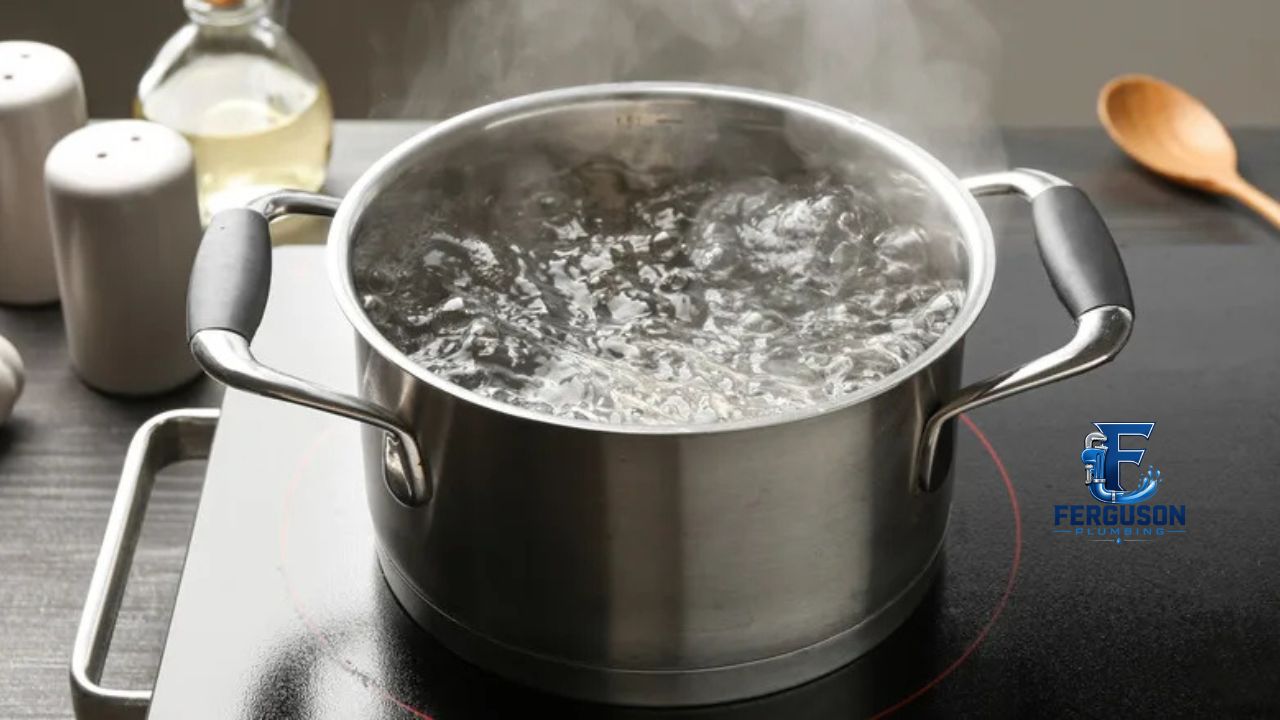
You have just cooked pasta, vegetables or eggs. The food is ready, the pot is heavy and the sink is right in front of you. Can you pour the boiling water straight down the drain?
The safest answer is no—especially when your drain pipe is plastic, the plumbing material is unknown or the sink is draining slowly. Let the water cool first or reduce its temperature before disposing of it.
Standard PVC drain, waste and vent pipe is commonly specified for operating temperatures no higher than 140°F. Water boils at approximately 212°F at sea level. That does not mean one splash will instantly melt every pipe, but it does mean boiling water is outside the normal operating range of a common residential drain material.
The condition of the drain matters as much as the material. Water passing rapidly through a clear metal drain presents less risk than boiling water collecting above a partial blockage and remaining against a plastic P-trap or joint.
The Quick Decision Guide
Use this simple rule:
| Your situation | Recommended action |
|---|---|
| White or black plastic pipe under the sink | Let the water cool. Do not make boiling-water disposal a habit. |
| Pipe material is unknown | Treat it as heat-sensitive and cool the water first. |
| Sink is slow or completely blocked | Do not add boiling water. It may sit against the pipe and fixture. |
| Drain is clear and the entire waste line is confirmed metal | Occasional hot cooking water is less concerning, but cooling it remains the cautious option. |
| You are trying to remove grease or hair | Use a method designed for that material rather than relying on heat. |
| You have already poured it down | Check drainage and inspect exposed connections for leaks or distortion. |
Why Boiling Water and PVC Are a Poor Match
PVC is widely used in residential drain, waste and vent systems because it is lightweight, corrosion-resistant and practical to install. It is not the same material as the pipe that carries hot water to a faucet.
This distinction causes a great deal of confusion.
The supply pipe delivers heated water from the water heater. Depending on the system, it may be copper, PEX or CPVC. The waste pipe carries used water away and is frequently PVC or ABS. A drain can therefore be attached to a faucet that safely supplies hot water even though the drain line beneath it has a lower temperature rating.
Charlotte Pipe specifies that its PVC DWV system is intended for non-pressure use where the operating temperature does not exceed 140°F. Its technical material also explains that PVC expands as temperature changes, which is one reason elevated temperatures and repeated thermal cycling deserve attention.
A pot of boiling water does begin cooling as soon as it leaves the stove. The sink basin, air and water already in the trap absorb some heat. That is why a single accidental pour does not automatically mean the pipe has failed.
Still, several conditions can increase the risk:
- A partial clog slows the water and lengthens its contact with the pipe.
- A plastic P-trap sits immediately below the drain opening.
- Slip-joint washers, rubber seals or transition couplings are present.
- The pipe is poorly supported or already distorted.
- The fixture and pipe are unusually cold.
- Large volumes are poured repeatedly.
The practical conclusion is not that every pot causes an emergency. It is that there is little benefit in routinely exposing a heat-sensitive system to water that exceeds its specified operating temperature.
What About ABS, CPVC and Metal Pipes?
PVC
PVC is often white and is common beneath modern sinks. Manufacturer literature for PVC DWV systems commonly lists a maximum operating temperature of 140°F. Boiling water is well above that figure.
ABS
ABS is usually black and is also used for drain, waste and vent systems. Exact limits depend on the manufacturer and product. Do not assume black plastic is safe simply because it is not PVC. Check the pipe markings or technical documentation.
CPVC
CPVC is formulated for higher-temperature applications than standard PVC and is commonly used in hot-water supply systems rather than ordinary sink waste assemblies. Charlotte Pipe documentation lists higher limits for CPVC products, but even those limits depend on the exact product, pressure and application. A CPVC supply line does not prove that the drain beneath the fixture is also CPVC.
Cast iron, copper and steel
Metal drain pipes tolerate heat better than standard plastic drain pipe. The weak point may still be a gasket, coupling, washer, seal or plastic section elsewhere in the assembly. Older metal plumbing can also contain corrosion or fragile joints.
Many houses use mixed materials. The exposed pipe under the sink may be metal while a concealed section inside the wall is plastic, or the reverse. When the complete route is unknown, cooling the water is the sensible choice.
Can Boiling Water Crack the Sink?
The drain pipe is not the only consideration.
A stainless-steel sink generally tolerates temperature changes better than a porcelain or ceramic fixture. Porcelain and ceramic can be vulnerable to thermal shock when a very hot liquid contacts a cold surface. Current home-maintenance guidance from plumbers repeatedly identifies cold porcelain fixtures as a higher-risk situation.
Do not pour boiling water into a toilet. Apart from the fixture itself, a toilet contains seals and a wax ring that were not designed to be treated as a boiling-water disposal route.
Does Boiling Water Actually Unclog a Drain?
Sometimes the sink appears to improve after a hot-water flush. That does not mean the underlying blockage has been removed.
The result depends on what is causing the obstruction.
Grease and cooking fat
Heat can temporarily liquefy grease. The liquid may move away from the sink, cool farther along the pipe and coat a less accessible section. Food particles can then stick to that residue.
This is why the sink may seem fixed for a short period before slowing again. The material has moved rather than disappeared. Several current plumbing guides identify this relocation and re-solidification problem as a major limitation of boiling-water treatments.
For a minor greasy film in a freely draining sink, normal hot tap water may help rinse residue. A substantial grease blockage usually requires physical cleaning or professional equipment.
Hair
Hot water does not dissolve a tangled mass of hair. Bathroom clogs often form when hair wraps around a stopper or combines with soap residue.
Remove the stopper and extract accessible hair with a suitable drain tool. This addresses the obstruction directly instead of heating it.
Soap scum
Warm or hot tap water may soften a light soap film, but a thick blockage often contains hair and other debris. Mechanical removal is more reliable.
Food particles
Water will not make coffee grounds, fibrous vegetable waste, rice, flour or similar solids vanish. A plunger, trap cleaning or drain snake may be required, depending on where the material is lodged.
A solid object
Heat will not remove a cap, utensil, piece of packaging or other solid object. Stop running water and retrieve the object if it is safely accessible. Otherwise, arrange professional removal.
Is It Safe to Pour Pasta Water Down the Sink?
The issue is its temperature, not the fact that pasta was cooked in it.
The easiest approach is to let the pot stand until the water is no longer near boiling. You can also reduce its temperature before disposal rather than sending a full pot of 212°F water directly into the drain.
A colander placed securely in the sink is safer than trying to hold it while controlling a heavy pot. Keep your face and hands away from rising steam and splashing water.
Do not intentionally pour oil, butter, meat fat or oily sauce into the sink with the cooking water. Heat may keep fat liquid for a few moments, but it can still settle after cooling.
What If I Already Poured Boiling Water Down the Drain?
Do not panic. One accidental exposure does not prove that damage occurred.
Take these steps:
1. Stop adding more hot water
Allow the assembly to return to a normal temperature. Avoid testing it with another kettle.
2. Look under the sink
Check the P-trap, slip nuts and visible joints. Look for:
- Fresh droplets
- Damp cabinet material
- A shifted connection
- A pipe that appears misshapen
- Water stains that were not present before
3. Run ordinary tap water briefly
Once the plumbing has cooled, run water and watch the exposed connections. Do not fill the sink if you already see a leak.
4. Pay attention over the next day
A weakened or displaced joint may not produce a dramatic leak immediately. Check the cabinet again after normal sink use.
5. Arrange an inspection when something has changed
Professional help is appropriate when you notice leakage, a newly sagging pipe, an unusual odor, cabinet swelling or worsening drainage.
Safer Ways to Deal With a Slow Drain
A drain remedy should match the likely blockage.
For a kitchen sink with food residue
Remove visible debris from the strainer. If a garbage disposal is installed, switch it off before reaching near the drain opening. Never place your hand inside the disposal chamber.
Once visible debris has been removed, try a sink plunger. In a double-basin sink, seal the other drain so pressure is directed into the blocked side.
For a bathroom sink
Remove and clean the stopper. Hair commonly collects directly beneath it, where it can often be extracted without treating the entire pipe.
For a shower or tub
Remove accessible hair from the drain cover and use a purpose-made hair-removal tool. A screen can reduce recurrence.
For a blockage in the P-trap
A removable P-trap may contain food or other debris. Because disassembly can release dirty water and create leaks when reassembled incorrectly, someone without plumbing experience should have a capable adult or plumber handle it.
For a deeper clog
A hand auger or drain snake can reach beyond the trap. Stop when there is strong resistance, when the plumbing configuration is unknown or when previous chemical drain cleaner may still be present.
Avoid combining household mixtures with commercial drain-opening chemicals. Mixing cleaning chemicals can produce dangerous reactions, fumes or splashback.
Common Mistakes to Avoid
Repeating the treatment because the first pour did not work
If the first pot did not clear the blockage, the water may be collecting against it. Adding more increases the exposure without diagnosing the obstruction.
Assuming the visible sink determines the pipe material
A stainless-steel basin may be attached to a plastic drain assembly.
Assuming old plumbing is entirely metal
Renovations frequently create mixed systems.
Treating grease as though it dissolves
Heat changes grease from solid to liquid. It does not remove the fat from the plumbing system.
Using boiling water after a chemical cleaner
This can increase splashing, fumes and reaction risk. Stop using the fixture and follow the product’s safety instructions.
Ignoring a recurring clog
A blockage that returns every few weeks may be deeper in the branch line or connected to an installation, venting or sewer problem.
When to Call a Plumber
Arrange professional diagnosis when:
- The drain is completely blocked.
- More than one fixture backs up.
- The sink gurgles when another fixture is used.
- Sewage odor is present.
- The clog returns soon after clearing.
- Water appears under the sink.
- A plastic P-trap looks distorted.
- A drain snake cannot pass the obstruction.
- Chemical cleaner is standing in the sink.
- Water rises in a shower or tub when a toilet is flushed.
Multiple affected fixtures can indicate a problem beyond the individual sink. A plumber may use a mechanical auger, camera inspection or another method based on the location and type of blockage.
The Bottom Line
You may be able to pour boiling water through some all-metal, freely flowing drain systems without immediate damage. That is not a safe general rule for modern residential plumbing.
PVC drain pipe is commonly specified for temperatures up to 140°F, while boiling water is approximately 212°F at sea level. The risk increases when the pipe is plastic, the material is unknown or a clog causes the water to remain in one place.
Let cooking water cool before disposal. For a clog, identify whether the problem is grease, hair, food or a deeper obstruction and use a method designed for that blockage.
9. FAQs
Will one pot of boiling water ruin PVC pipes?
Not necessarily. A single exposure may pass without visible damage, particularly when the drain is clear and the water cools quickly. However, boiling water exceeds the 140°F operating-temperature specification listed for common PVC DWV products, so it should not become a routine practice.
Can boiling water melt a PVC drain pipe?
It can soften or deform heat-sensitive plastic under sufficient temperature, volume and exposure time. A slow or blocked drain is more concerning because hot water remains in contact with the same section.
Should I run cold water while draining pasta?
Reducing the water temperature is safer than sending it into the drain at a full boil. Letting it cool before disposal is the simplest method. When using the sink, stabilize the pot or colander and avoid splashing.
Is boiling water safe for a garbage disposal?
It is better to follow the disposal manufacturer’s operating instructions. A disposal assembly can include rubber and plastic components even when the sink is stainless steel. Use the recommended water temperature and do not treat the unit with repeated pots of boiling water.
Does boiling water remove grease?
It may liquefy grease temporarily, but the fat can cool and accumulate farther down the pipe. Remove grease before washing cookware and dispose of it with household waste according to local requirements.
Can boiling water dissolve hair?
No. Tangled hair should be extracted from the stopper, drain opening or pipe with a suitable mechanical tool.
Can I pour boiling water down a bathroom drain?
Avoid it when the pipe is plastic, the material is unknown or the drain is slow. Bathroom blockages commonly involve hair, which boiling water does not remove.
Can I pour boiling water into a toilet?
No. Sudden heat can damage the porcelain or affect seals. A toilet should not be used to dispose of boiling liquids.
What water temperature is safer for PVC drains?
Stay within the specification for the installed pipe system. The Charlotte Pipe PVC DWV documentation reviewed lists a maximum operating temperature of 140°F. Product ratings can vary, so check the markings and manufacturer literature for the actual installation.
Why did boiling water make my sink drain faster?
The heat may have softened soap or temporarily liquefied grease. An improvement in flow does not prove that the material left the system; it may have moved farther into the line.